
This week we launched Nuvo AI. You can read more on LinkedIn and Freightwaves.
To explain the value prop of Nuvo AI, we chose a fun analogy to the Roman empire to explain how Nuvocargo brings together human freight experts, our proprietary platform NuvoOS, and an army of AI agents to manage North American truckload freight end-to-end. Watch the launch video here!
This Substack post is designed to go one level deeper and explain why we believe our approach of being the full stack AI services provider is a powerful strategy - both for our customers and for our business. I believe the benefits of our strategy are very analogous to what will happen with AI in most other large, complex professional service industries.
In essence, our biggest learning is that the most important thing we’re building isn’t a product feature or a particular AI agent. It’s a full stack AI-native operating model. And after ~24 months of deploying AI in freight operations, we have a lot of conviction that this model is the right one - and some insights into why other approaches are not really working.
The smartest investors in Silicon Valley are arriving at the same conclusion. Sequoia recently published a piece called Services: The New Software arguing that the most defensible AI companies won’t sell software tools - they’ll sell the work itself. As Julien Bek from Sequoia puts it: “If you sell the tool, you’re in a race against the model. If you sell the work, every improvement in the model makes your service faster, cheaper, and harder to compete with.”
Foundation Capital has pushed this further with their System of Agents thesis — the idea that “Service as Software” is only truly realized when you orchestrate a coordinated system of agents driving outcomes end-to-end, not just individual AI tools.
That is exactly what we are building in North American freight. Here’s what we’ve learned doing it.
The alternatives - and why they’re structurally limited
When you look at the freight tech landscape, there are basically four models competing for the future of AI in managing & executing freight:
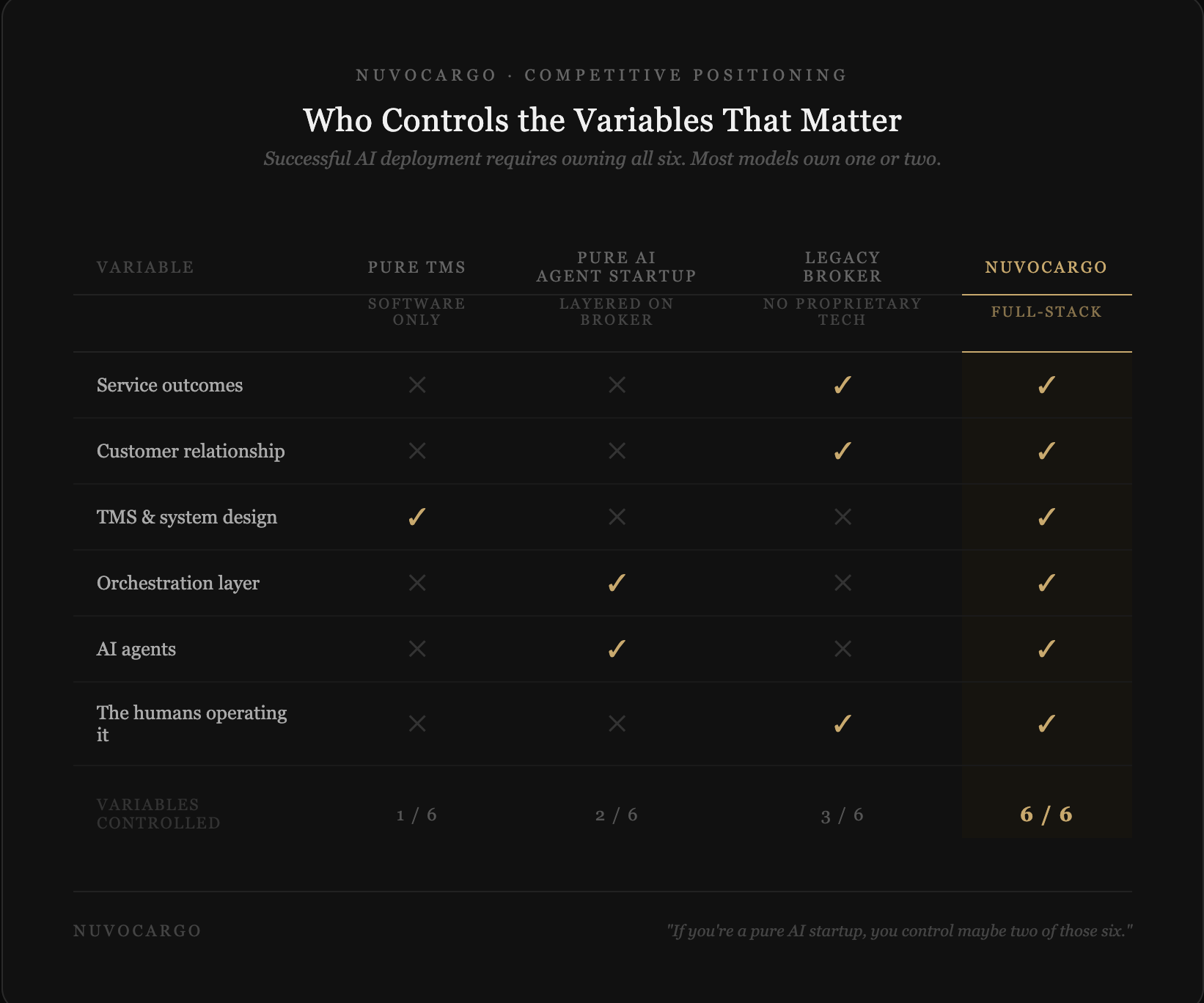
Pure TMS companies. Great software, but they have a fundamental problem: every customer uses them differently. In brokerage alone, you have the “split model” and the “cradle to grave” model as one example. Three companies can run on the same TMS and operate in radically different ways with completely different business rules, SLAs, and incentive structures. That makes it nearly impossible to build general purpose AI that drives consistent outcomes across your customer base.
Pure AI agent startups. These are layering AI on top of legacy brokers. The demos are incredible — and I mean that sincerely. Watching a voice AI negotiate a carrier down $50-100 on a load is genuinely amazing. But the leap between a nice demo and deploying that technology across thousands of daily transactions in a way that drives true outcomes is extremely hard. You’re at the mercy of change management and company politics. When something goes wrong - and things always go wrong in early AI deployments - the broker blames the AI startup. You’re the unproven 3rd party vendor; they’re the customer. Behind the scenes, a lot of these “AI for brokers” models are struggling to renew contracts and prove positive ROI. We hear constant private conversations about the massive tension between the AI vendors and their broker customers who signed on 1 year ago when discussing renewals - the ROI is hard to prove, and the big monthly spend on these AI vendors is hard to justify. And if AI agent startups decide to go full stack- they will have to decide to compete with their entire existing customer base.
Legacy brokers without proprietary tech or a legacy homegrown TMS. If you don’t build your own modern software and AI, you have zero proprietary advantage. You’re just another customer for the 50+ TMS companies and the AI startups that are all figuring it out. You’re adopting a ton of disconnected tools — TMS, rate visibility, carrier compliance, GPS, document processing — without any of them working together seamlessly. And none of it compounds into a real moat. There are a lot of scaled incumbents touting their $100M+ annual spend on technology in the last 5-10 years. None of that matters either if you haven’t radically readjusted your technology strategy and attracted high quality teammates fluent in AI in the past 24-36 months. Even if you have an incredible AI team, change management and iteration on your technology is highly complex & slow with a large headcount (more on that below).
Why the full-stack AI-native model is different
At Nuvocargo, we are the brokerage, the managed transportation provider, the customs broker, the TMS, and the AI orchestration layer — all at once. To get here, we built an entirely AI-native TMS in early 2024 and iterated for 2 years with an incredibly lean team - to avoid the trap of change management and slow iteration.
That combination has been transformational for Nuvocargo.
First, it has created real discipline on where to invest in AI. We are not paid for tokens, per seat SaaS, or for running a successful pilot. We get paid to deliver loads end-to-end at a competitive price, at a low cost to serve, either as a freight broker, or managed transportation provider. That means every AI investment has to drive real ROI on high-leverage tasks that actually move the needle. We can’t afford to build impressive demos that don’t translate to outcomes. Our P&L keeps us honest.
Second, it’s the only model where AI deployment actually works. Think about what it takes to truly deploy AI in freight operations. You need to control all of these variables simultaneously:
The service outcomes
The customer relationship
The TMS and system design
The orchestration layer
The AI agents
The humans operating everything
If you’re a pure AI startup or a TMS working with a legacy broker, you control maybe two of those six. Iteration is painfully slow. And when you need to change the UI, the business rules, the job descriptions of the people running the system - you can’t, because those aren’t your variables to change.
We own all six. When we realize that our platform now sources 90% of loads autonomously, we can simultaneously update the agent logic, the TMS interface, and the role of our carrier reps - turning them from phone-bangers into agent supervisors who tweak business rules and catch edge cases. That’s a completely different job, and we can actually make that transition happen because we control the whole system.
Why incumbents can’t replicate this
The most common pushback to these claims is: what stops a North American scaled freight incumbent from hiring a team of engineers and doing the same thing?
A few structural answers:
Headcount is a liability, not an asset, in the AI transition. When you can execute freight audit and pay workflows with 5 people instead of 50, the politics required to make that change happen inside a large company are immense. The leader of that organization has to a) embrace and learn the new AI tools, b) realize their headcount is bloated by 10x, c) actually have the incentive to make bold changes when headcount is a proxy for your influence, budget and importance in most large orgs, and d) take that kind of risk when they’re reporting to a public market with quarterly earnings. These transitions are not smooth. And the people whose jobs are at stake will not make it easy.
Even if they try to outsource AI to third parties - that’s not a proprietary advantage. If a startup builds your AI for you, you’ve learned nothing, you’ve built nothing, and the moment that startup raises prices or pivots, you have no leverage. You are not compounding AI learnings into a sustainable competitive advantage; you are just helping train the vendors who are also making your competitors smarter on AI. And in freight specifically, if technology isn’t already in your DNA, you will not attract the AI talent required to drive true and lasting differentiation.
The TMS problem. Most scaled legacy brokers run on old-school third-party TMS systems that are hard to iterate on. They can’t change the UI or the system design in response to what they’re learning about AI deployment. They’re customers, not builders.
The flywheel - and why timing matters
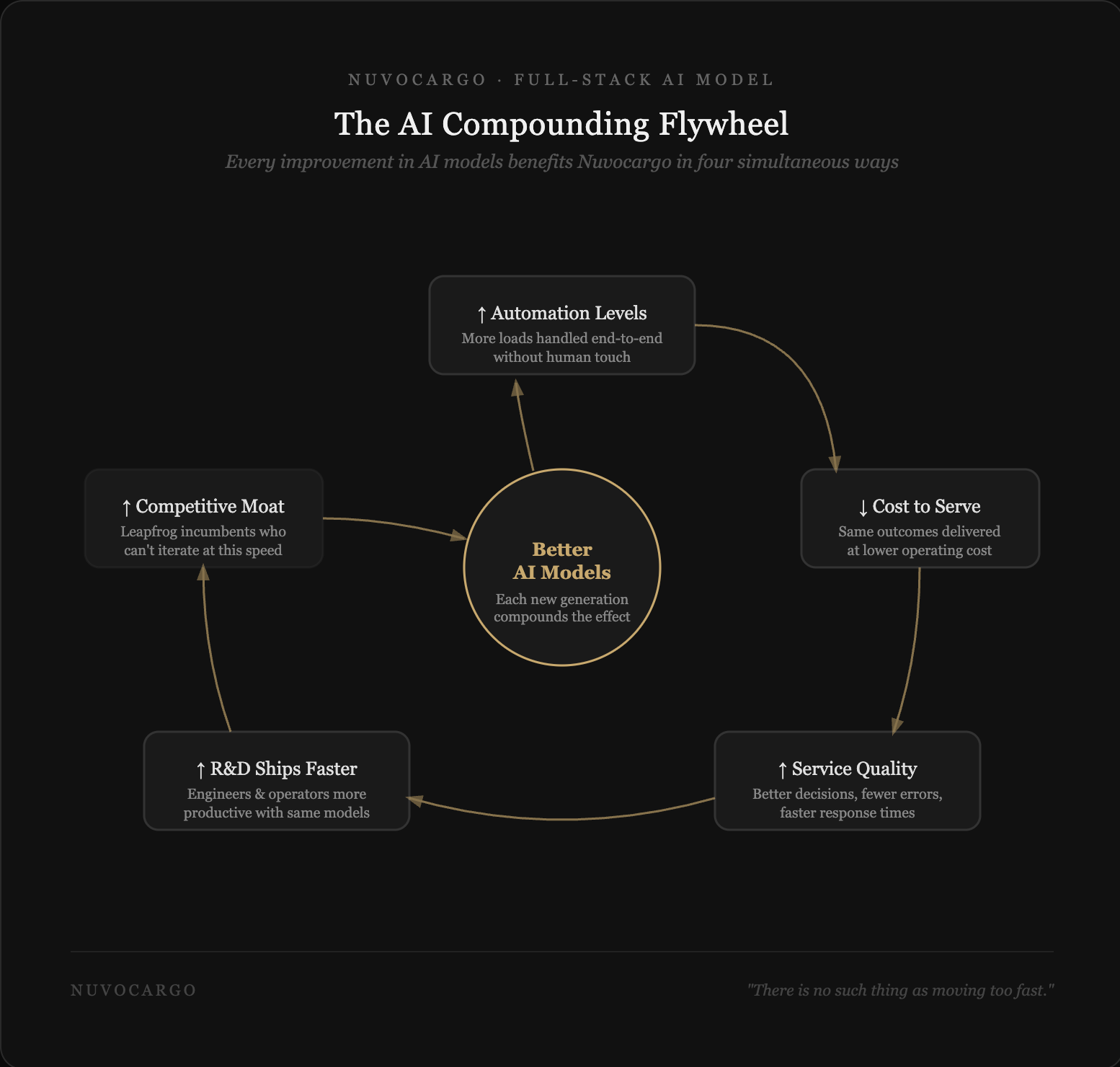
My biggest learning in the past 12 months as AI has gotten exponentially better is that our model benefits in multiple compounding ways as AI gets smarter.
Every time AI models get better, four things happen for us:
Our automation levels go up
Our cost to serve goes down
Our service quality to customers goes up
Our R&D team ships faster
The same model improvements that make our agents more capable also make our engineers and operators more productive. The whole system accelerates together. We already got a taste of that in 2025, and saw it compound only in the last 120 days with the launch of Anthropic and OpenAI’s latest models released in November/December.
If we were just an AI agent startup, faster AI progress would eventually commoditize us. Anyone could spin up a competitive agent. But because we run the agents, the TMS, and the service - there is no such thing as moving too fast. The faster AI progresses, the more we leapfrog the old-school competition and become the obvious, ROI-positive choice for shippers.
The M&A angle — and why AI rollups should pay attention
There’s also a consolidation dimension here that I think is underappreciated.
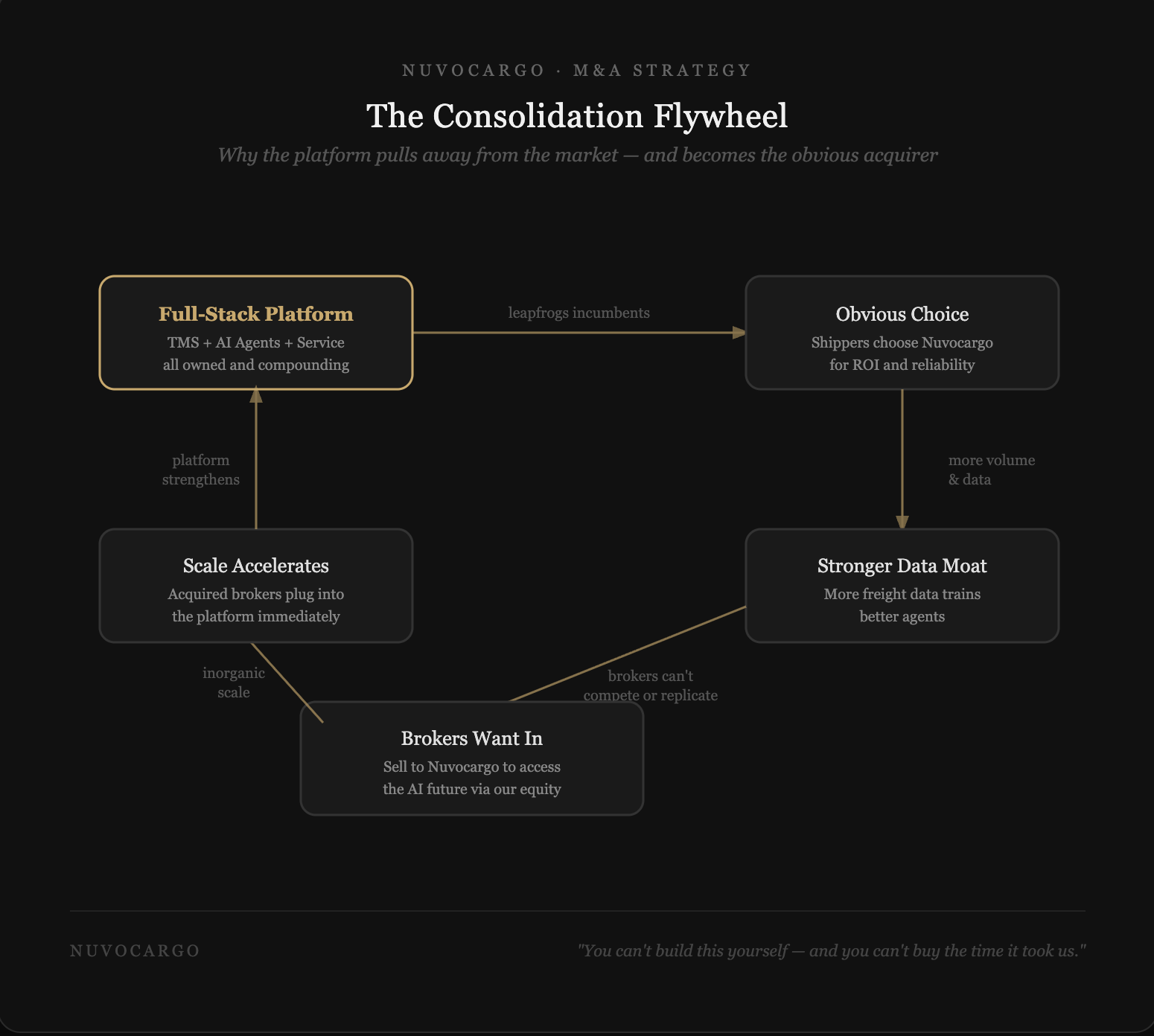
Because we’ve already spun this flywheel - built the AI-native TMS from scratch, trained the agents on real freight data, rebuilt workflows from the ground up, re-trained our people to work alongside AI agents - we have a structural head start that would take any new entrant years to replicate.
This is an important distinction that often gets overlooked when analyzing brand new AI rollups. There is a class of investor today looking at freight and thinking: “I’ll find a broker, bolt on some AI, juice EBITDA by 10-20%, and exit.” That’s not what we’ve done. We didn’t slap AI onto a legacy operating model to manufacture a quick return. We rebuilt the entire system from scratch, which is precisely why the flywheel is structurally hard for others to spin. If you just start slapping on AI tools on top of a legacy TMS for a new rollup, you’ll have the same challenges as big incumbents, just at a smaller scale.
All of this has exciting implications for Nuvocargo’s inorganic growth strategy. As our platform pulls away from the market, the calculus for a traditional broker increasingly becomes: you can’t build this yourself, and you can’t buy the time it took us to build it.
The most logical path is to consider selling to Nuvocargo and participate in the equity upside. Our equity becomes a compelling offer to brokers who understand the AI transition is coming for their business model whether they act or not. We become an attractive acquirer - not because we’re the biggest, but because we’re the only ones with a platform that makes a broker meaningfully better the moment they bring their shippers, carriers, and employees onto the platform.
What this looks like for our customers (shippers) today
If you’re a shipper and the market plays out the way I’m describing, I believe the implication for you is simple: the sooner you work with a full-stack AI freight partner, the faster you compound the benefits.
In our experience, the outcomes shippers care about right now are the following:
Spend less on freight
Improve service levels
Simplify your tech stack with less vendors and more accountability
Stay ahead on AI
A full stack AI partner like Nuvocargo holds ourselves accountable to all four of those outcomes. Hundreds of our customers have already seen:
7–20% freight spend reduction in year one
30–50% improvement in OTIF
Hundreds of thousands of dollars eliminated in annual software spend
Hundreds of hours of manual work eliminated for their teams
With a partner like Nuvocargo, the value to you as the shipper is only going to accelerate as AI models get better - thanks to the foundational work we have done.
You can get started with Nuvo AI with as little as ten truckload shipments. No long implementations. No rip and replace. We can help you see positive ROI and the power of AI in your supply chain in weeks.
If you’re a shipper or work closely with one and want to see NuvoOS in action, book a demo with our team HERE. If you just want some entertaining content about freight, AI, and the Roman empire - watch our launch video HERE!
If you’re an investor or operator thinking about the future of AI in professional services and freight or AI enabled rollups, I’d love to get your reactions to this post. Reply to this post or reach out directly.
Full-stack AI services in freight is exactly the kind of real-world deployment story that cuts through the hype. The hardest part is never the model. It is the integration with existing ops workflows, the data quality pipeline, and keeping the system reliable under production load. Curious what your biggest surprise was going from prototype to production.