
We’re living through a moment where AI is the number one topic in every industry, and freight is no exception. But as I wrote about in my last Substack post, most AI vendors in freight aren’t actually driving outcomes. They’re selling it as a small feature bolted onto a legacy system for a legacy process — one that doesn’t make sense if you really understand what the technology is now capable of doing.
Nuvocargo is on the cutting edge of applying AI to freight in ways that are actually working. But much like a lot of other Silicon Valley startups watching the cost of building software approach zero, the risk isn’t building too little — it’s building the wrong things that customers don’t care about.
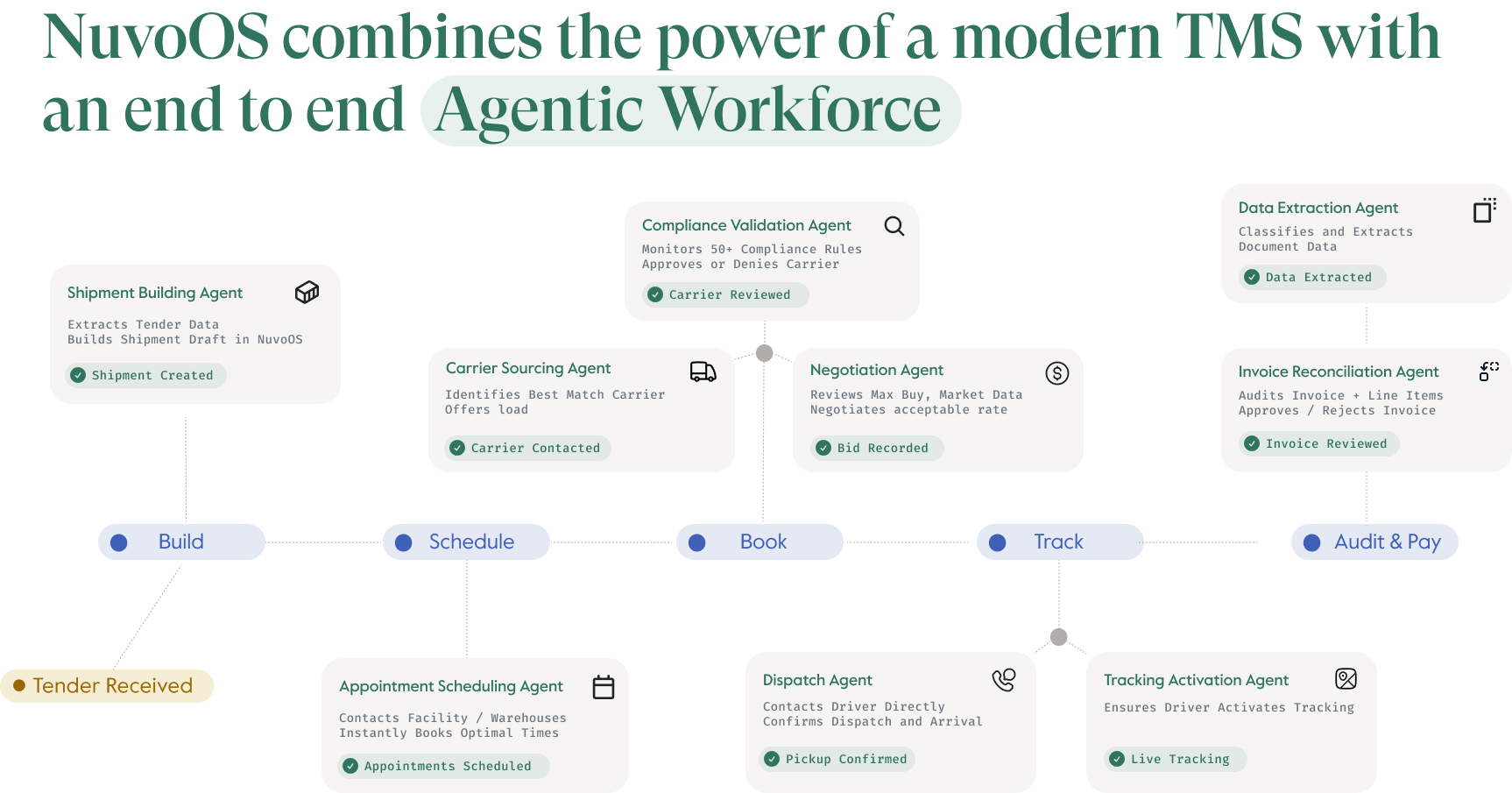
So we want to be clear, both internally and to the world: everything Nuvocargo builds is for the benefit of our customers, to drive concrete outcomes at a cost that has never been possible before. That’s what we use AI for.
Through thousands of customer conversations and working with hundreds of shippers, we’ve learned that our value proposition falls squarely in four buckets. The purpose of this post is to hold ourselves accountable as a company for making sure everything we build adds value in these four areas. Over the next few Substack posts, I’ll be diving deep into each one.
These are the four things our customers consistently tell us they care about most when it comes to managing and executing their North America freight:
1. Reducing freight spend
2. Improving service levels
3. Simplifying your logistics tech stack
4. Staying ahead on AI
1. Reducing freight spend
For the shippers, manufacturers, distributors, and retailers we talk to, freight and logistics is consistently one of their largest cost items. Reducing spend — or at the very least avoiding unnecessary cost increases — is always top of mind.
This is especially urgent right now. The North American freight market is entering an inflationary cycle. Spot linehaul rates have climbed roughly 28% in less than a year, carrier capacity is tightening, and diesel prices recently saw the largest single-week spike ever recorded. In a market like this, being passive about your freight spend is a fast way to watch your costs balloon.
What we’ve learned working closely with our customers is that avoiding unnecessary cost in freight requires a few things working together:
Hold your existing providers accountable to results and rates benchmarked against the market
Run bids consistently for both contract and spot so you always know where your rates stand
Implement routing guides that enforce discipline
Access as many carriers as possible to maximize competitive tension on every load
Have a robust spot market motion for when the market shifts
Automate the grunt work — so your team isn’t burning hours coordinating across a sprawl of tools, vendors, and carriers as markets change and fuel prices fluctuate
Most shippers know they should be doing all of this. The challenge is that doing it well, consistently, across every load, is an enormous operational lift without the right technology. That’s exactly where we believe AI makes the biggest difference, and we’ll go deep on how we’re driving freight spend reduction in our next post.
2. Improving service levels
As shippers grow their freight spend, complexity starts to take over. If you’re a growing business with physical products, you’re shipping to different destinations, setting up new facilities, going into new retailers, finding new distributors — and your supply chain starts getting complicated fast.
Each relationship in your network comes with different expectations. Shipping internally to your own facilities is a completely different motion than shipping to an end customer who cares about real-time visibility and tight appointment scheduling. But across all of them, the fundamentals are the same: your customers and partners care about reliable service levels. They care that shipments are picked up and delivered on time, in the way that was expected. They care that carriers are meeting their commitments. And they care about being able to analyze what actually happened in their supply chain so they can make better decisions going forward.
The metrics that matter here are ones that every shipper knows but few have a clean way to track:
On-time pickup
On-time delivery
OTIF (on-time, in-full)
Landed cost per shipment
Landed cost per SKU across their catalog
And more
Today, the status quo makes it really difficult for shippers to collect all of this data in one place and turn it into something actionable. We’ll go deep on how we’re solving this in a dedicated post on service levels.
3. Simplifying your logistics tech stack
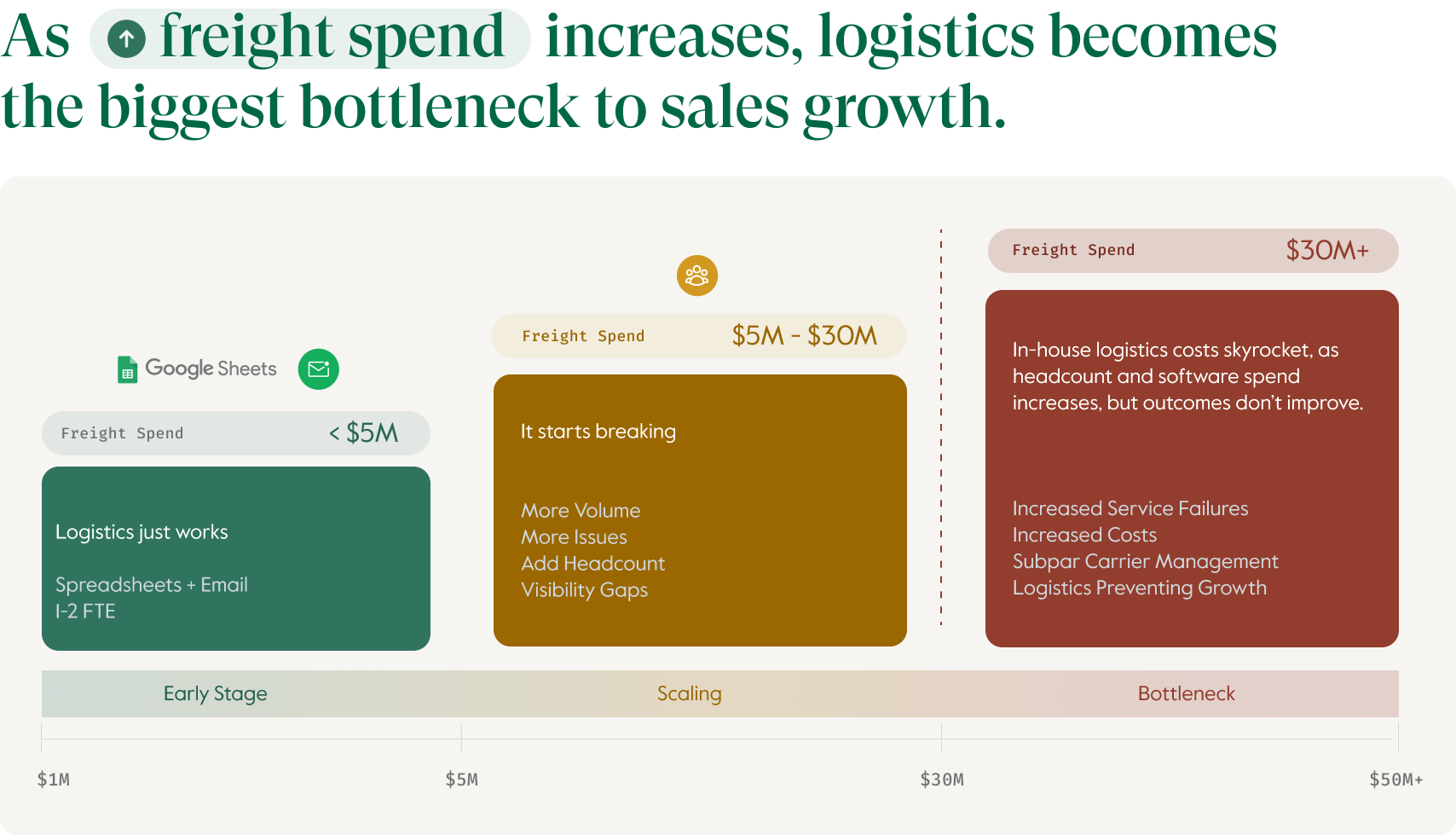
Most shippers start managing their freight with spreadsheets and email. It works fine when you’re spending less than $3-5M a year on freight. But as your spend grows and complexity kicks in, you realize you need to optimize — and that’s when the vendor creep begins.
First you implement a TMS like Oracle OTM or MercuryGate. Then you add a visibility platform like project44 or FourKites. A rate benchmarking tool like DAT, Greenscreens, or Sonar. A bidding platform like Emerge, Coupa, or Jaggaer. A carrier compliance solution like Highway or GenLogs as fraud becomes rampant in the space. Something to handle EDI and integrations. Freight audit and pay. BI and analytics. Middleware to connect it all. And now, with the boom of AI, you’re getting pitched by a dozen new solutions launching every month from AI appointment scheduling, AI quoting, to voice AI agents for carrier negotiation, and more; this creates more complexity, not less.
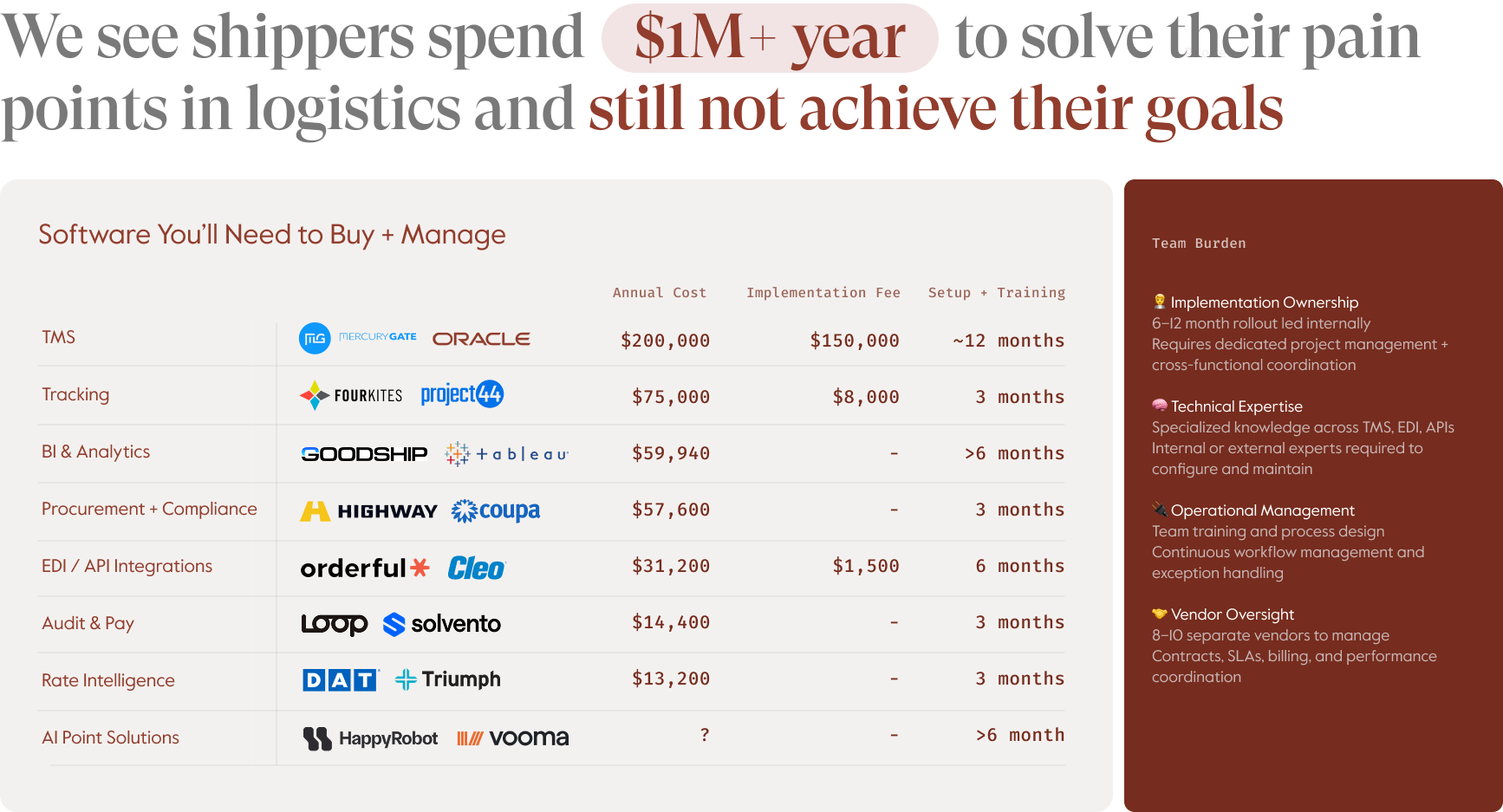
For the most innovative shippers we’ve spoken to since we started Nuvocargo, this journey has meant managing 15+ tools, vendor relationships, and contracts. Sometimes these tools have interdependencies; one subscription change on tool #3 can affect the effectiveness of tool #14 and has downstream impacts on your entire supply chain workflow. This whole set up is frail and it is definitely not the way of the future.
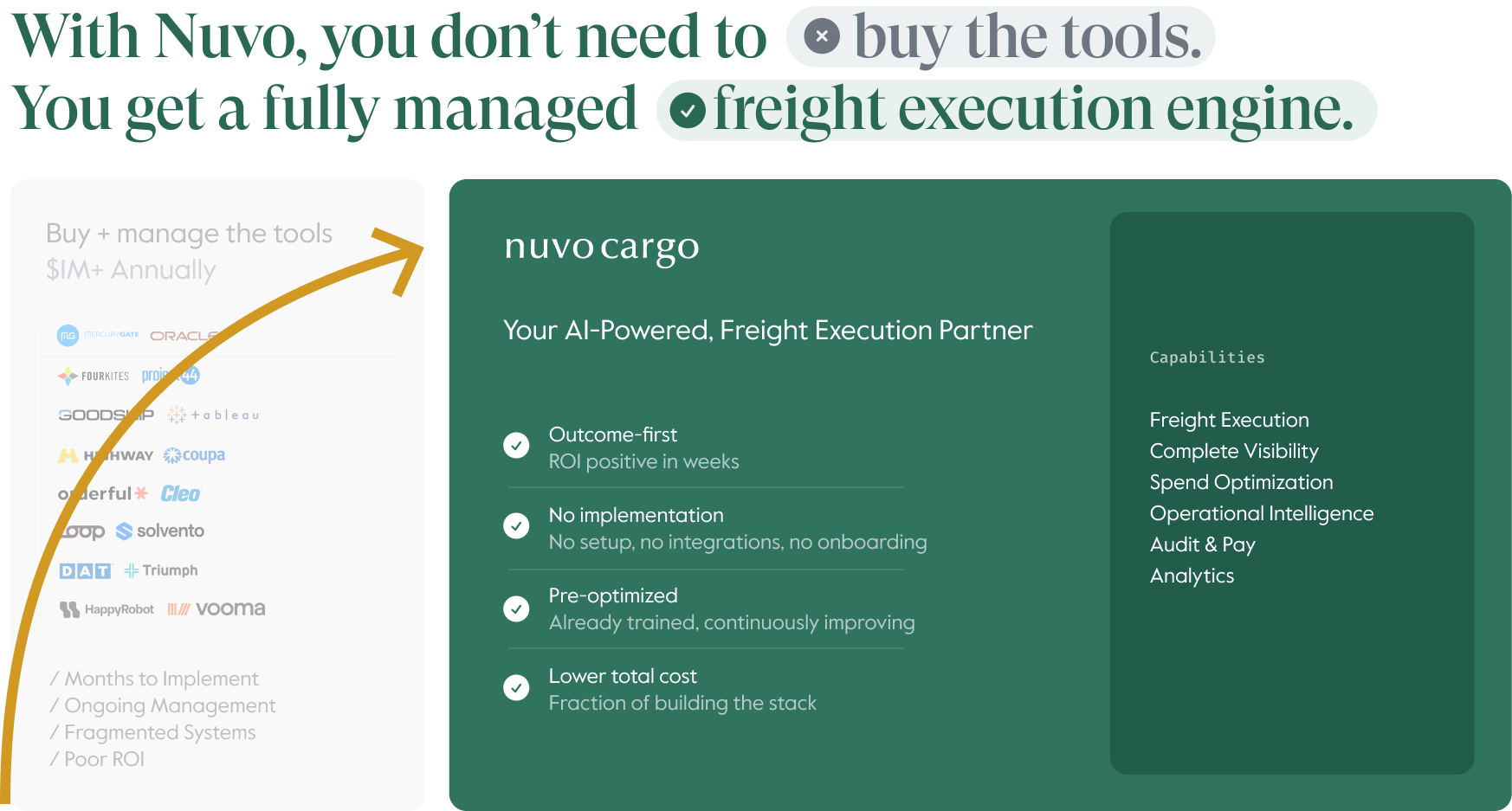
We firmly believe the future needs to be something seamless and simple — a single platform that gives you the benefit of all 15 or 20 of these tools and drives real outcomes, without the sprawl. That’s what we’ve built with Nuvo AI, and we’ll also go deeper on that in a subsequent post on how to simplify your logistics tech stack.
4. Staying ahead on AI
We hesitated to include this as a value prop because, as I’ve said repeatedly, we see AI as a tool to drive outcomes — not as a value prop in itself. But we’re living in an unprecedented time where AI as a technology is changing so quickly, almost on a daily or weekly basis, that it becomes overwhelming to know if you’re making the best decisions. The vendor you pick today could be obsolete or too expensive two or three months from now. We see this all the time — companies that were leaders in a particular area, like voice AI for freight or appointment scheduling, become obsolete or too expensive three to six months later as more competitors enter the space or the cost equation shifts.
One thing we’ve learned over two years of evaluating 100+ AI vendors is that you really want to build your tech stack so you can always adopt the latest AI models and applications that do the job well for any given part of the stack. As you can see in the visuals above and in our prior post on full-stack AI, Nuvocargo is extremely holistic across the entire lifecycle of a shipment — from a purchase order all the way to paying out your carriers and reporting on analytics.
There are so many different use cases and areas inside the life of a load where we’ve already swapped vendors more than two or three times in the past year alone. We do that through a rigorous ROI exercise. We are able to do this because we have our own Silicon Valley R&D team that’s on the cutting edge of AI. And when we determine there’s a way to drive better outcomes at a lower cost — whether that’s a newer vendor or something we can build directly on LLMs ourselves — we make that change on behalf of our shippers.
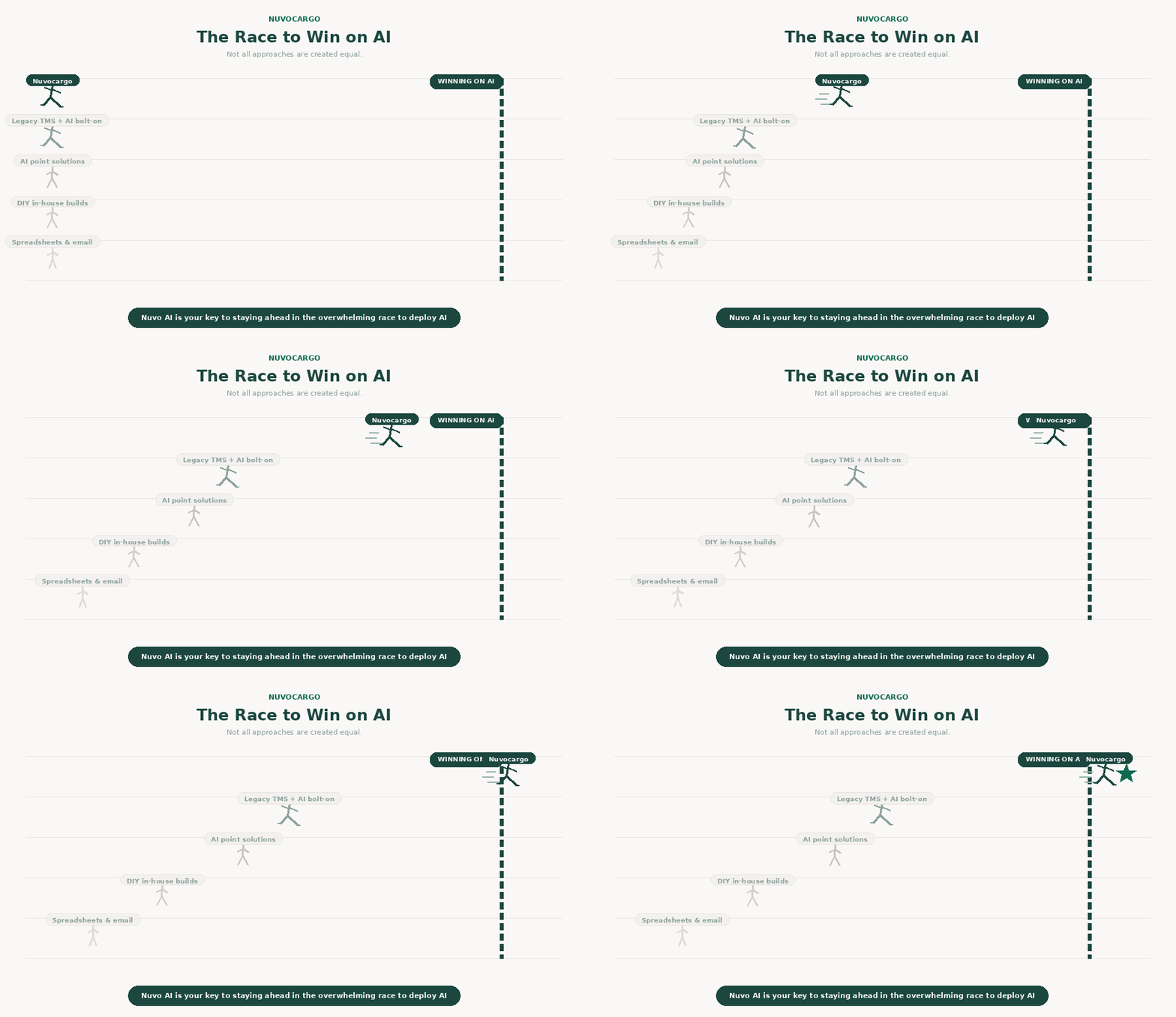
Our shippers don’t have to waste their time thinking about the 25th new vendor or the latest update from OpenAI or Anthropic. That’s all out of the box with Nuvocargo — completely applied to your freight, always driving the best outcome at the best cost. We’ll share more about how we help our shippers stay on the bleeding edge of AI in a separate subsequent post.
———
Over the next four posts in this series, we’re going to go deep on each of these pillars — what we’ve built, what results we’re seeing, and what it means for shippers evaluating their options. Please subscribe at the bottom so you can get these right in your inbox!
If you’re a shipper and want to see Nuvo AI in action — not a demo, but the real system running across real shipments — you can get started with as few as ten truckload loads. Book a demo with our team here.
If you’re an investor, operator, or founder thinking about the future of AI in services, I’d love your reactions. Reply to this post or reach out directly.
Well done Deepak!!
Es increible como la IA va avanzado y podemos hacer mas con menos en los procesos logisticos cuando conoces como debe moverse la informacion en los canales adecuados!
Me gustaria formar parte de Nuvocargo para poder poner en practica mis conocimientos de IA y crossborder que he desarollado en los ultimos 12 años!
Donde puedo enviar mi cv!
saludos