
In my last post I covered the first of four outcomes we strive to deliver for our shippers: to reduce their freight spend. I discussed how Nuvo AI helps you access over 300,000 carriers to find more options for capacity, uses multiple AI agents & market benchmarking data to negotiate bids for you, and screens for compliance on every single bid to avoid fraud. This results in our shippers finding more high quality carriers at cheaper rates and reducing their spend.
This post is about the second of four outcomes we strive to deliver for our shippers: improve service levels (think OTP, OTD, OTIF, landed cost per shipment, among others). Reminder: you can book a demo of Nuvo AI with our team here to see the platform yourself in action.
Improving freight service levels
If you’ve worked in logistics, you know this moment: A customer calls asking where their shipment is, and your TMS says it’s in transit, but the tracking link shows the truck hasn’t moved in four hours. You call the carrier and nobody picks up, so you call again, and eventually you find out the driver was never sent.
By then the delivery appointment window is no longer available, so the load fails and you end up writing the apology to a customer and updating a spreadsheet manually, creating more manual work to try this load again. A few months later someone puts a chart up in a review showing your on-time numbers got worse, and everyone nods, because everyone already knew. The retro on how to improve this happens weeks later when the shipment is no longer a priority, and you’ve moved on to put out other fires.
The frustrating part is that all the information was there the whole time. You just didn’t have a simple way to act on the data while there was an opportunity to prevent failures & exceptions in the first place. It isn’t that shippers don’t have the data, it’s that nothing turns that data into action fast enough to save the load. There’s too much key data across too many platforms and silo’s.
With Nuvo AI, we’ve found a powerful way to fix this problem and improve service levels with one single partner (not 5+ silo’d tools with the data you need).
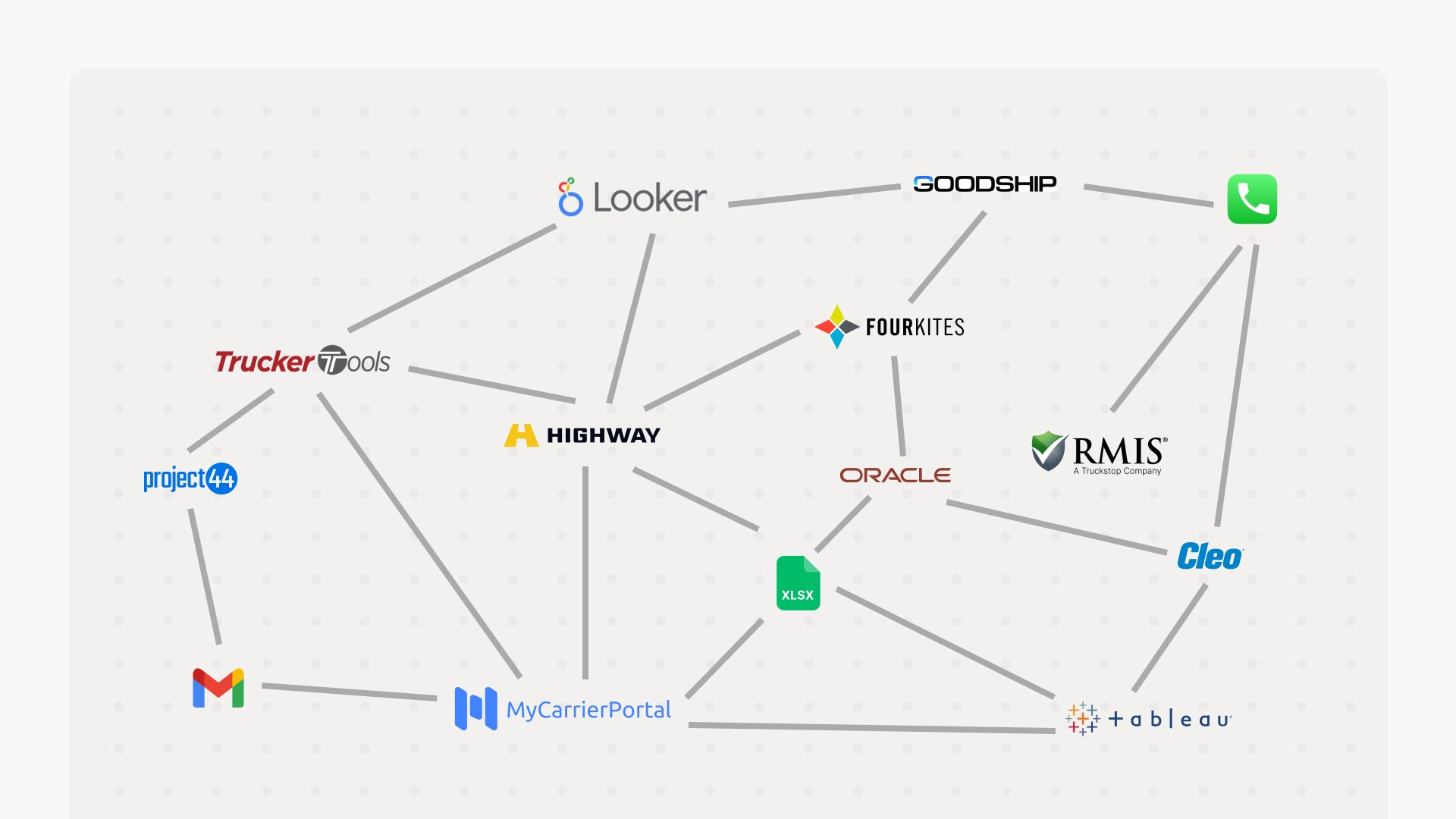
Nuvo AI offers both measurement of data and suggested actions to avoid failures
Nuvo AI has rich data that is timely, accurate, and complete for the entire lifecycle of a shipment. We’ve built in the logic so that when there is an imminent failure, it can be measured, flagged, and there’s still time to fix things to avoid the upcoming failure.
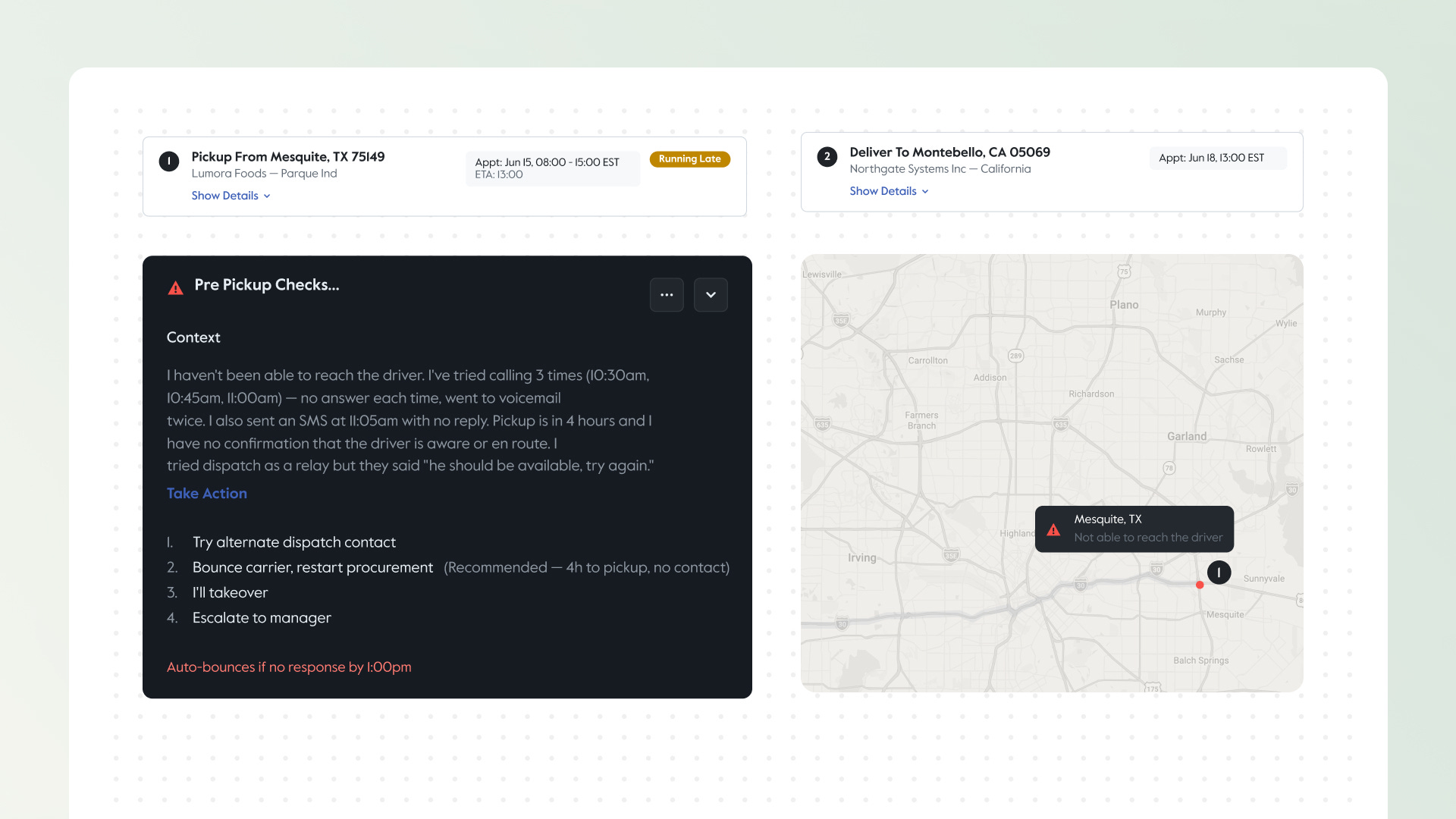
It starts with all the key shipment data living in one unified platform. Every load runs through a single record, so the same system that books the carrier also sets up the appointment, checks that everything is ready before pickup, follows the truck along the way, marks it delivered, and checks the invoice at the end. There’s nothing to piece together later, because the information is created right inside the system that’s actually running the freight.
On top of that, our AI agents do the work instead of just sending you an alert. They lock in the appointment before we ever hand the load to a carrier, they reach out to the dispatcher hours before pickup to make sure the truck is ready, and if a driver hasn’t finished their last delivery in time, the system notices early enough that we can still put the load on another truck. While the load is moving, problems show up before they actually hurt the delivery, and the team gets a simple list of which loads need attention and what to do about each one.
The other powerful thing about Nuvo AI is that every load gets the same care and consistent quality. A great coordinator can stay on top of their 20 biggest accounts, maybe 50 loads on a good day, but nobody can do that across 500 loads or 2,000. Our AI agents don’t have favorites, so the first load of the day and the five-hundredth get treated exactly the same.
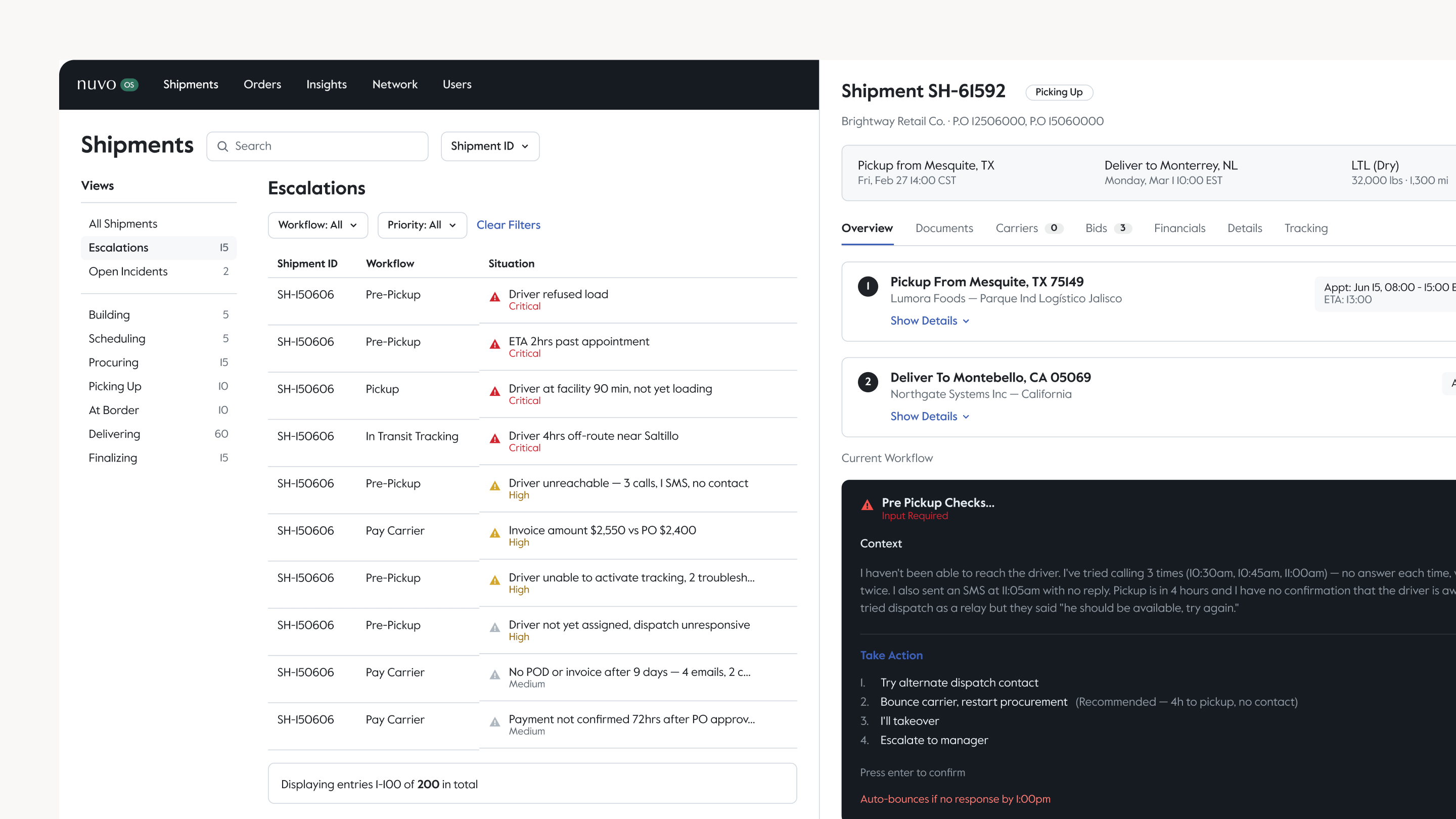
Most of this runs on its own. Nuvo AI handles the bulk of the work without anyone touching it, including setting up appointments, checking details, watching loads, chasing problems, sending updates, collecting paperwork, and reviewing invoices. However, anyone who has worked in freight knows that exceptions and failures arise all the time. For those, Nuvo AI escalates to our dedicated human freight experts who step in to help unblock issues at each stage of the life of a load, systematically.
Nuvo AI vs. the status quo in freight tech
We’re not a tool sitting on top of someone else’s freight operation: we execute your loads as a logistics provider, we control the TMS (Nuvo OS), the orchestration layer, all the 12+ AI agents, and the integrations with all the third party tools providing key data to move things along the life of a load. That’s why, when something goes wrong, nobody has to pass it off to another tool or another team - we take care of it and we fix whatever the problem is - be it a technology problem, a process problem, or an operational problem.
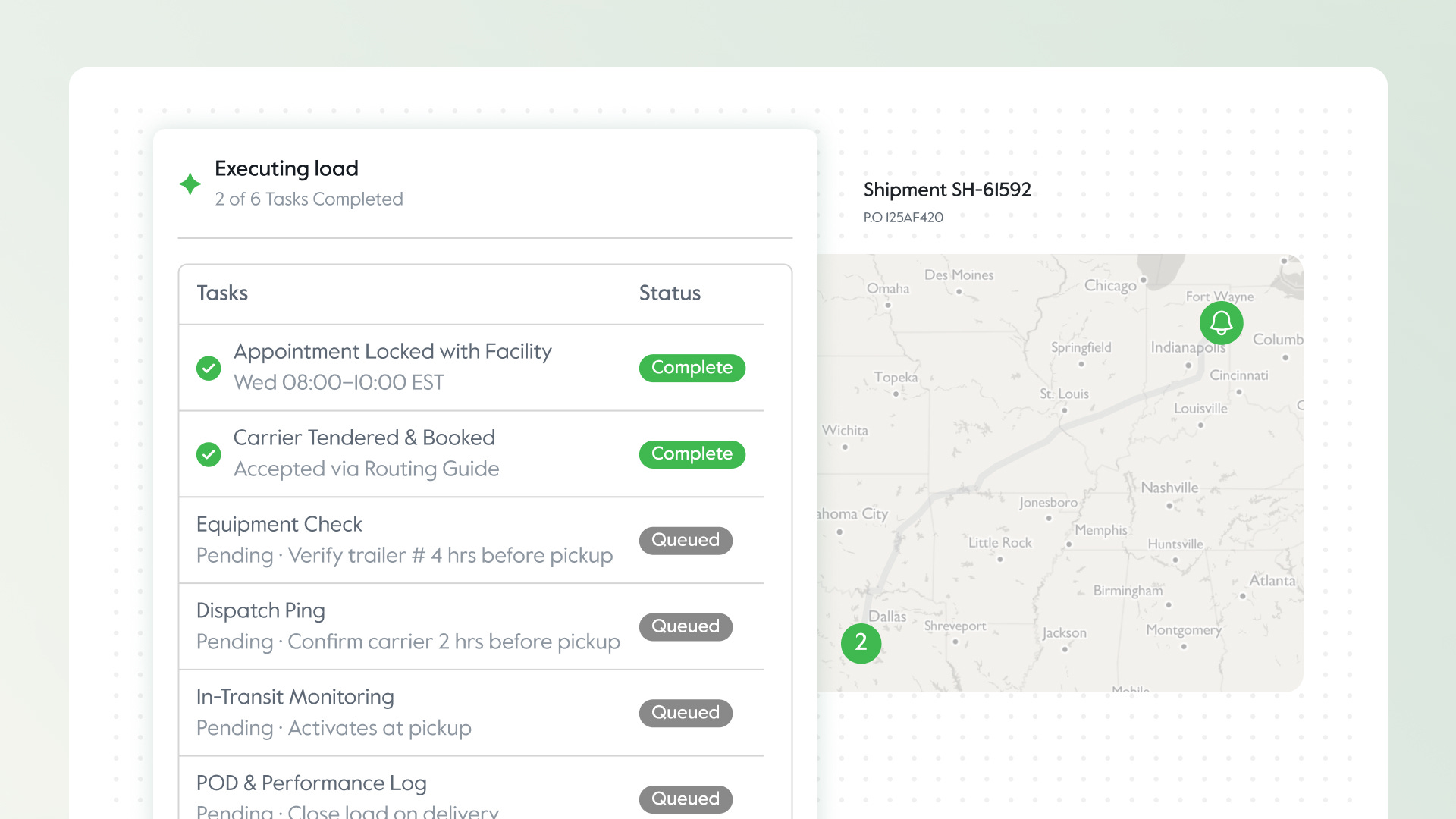
These improvements have a powerful compounding effect thanks to AI. For every single edge case we build into the platform and train our agents on, NuvoOS can execute more loads, more modes, more permutations, and do it with fewer errors. As AI models and tools get better, our service quality goes up in effectiveness and down in cost. A regular broker runs about the same way after a thousand days as it did on its first one, while our system knows more about your freight this month than it did last month.
Upcoming posts
For the next post, I’ll talk about the third of our outcomes we drive for our shippers: simplifying their logistics tech stack. Subscribe below and you’ll get an email in your inbox explaining how Nuvo AI allows you to get the value & power of more than 15 SaaS and AI tools with one unified AI native partner.
If you want to see how Nuvo AI handles problems, pickup checks, and on-time delivery on real freight, you can start with as few as 10 truckload shipments, and within 14 days you’ll have real numbers on your own lanes. You can book a demo with our team here.
Thanks for reading!